Vintage Erotic Art Signatures Vintage Erotic Art Signatures Ink
7 important things to know virtually creative person signatures
Holly Black consults Christie's specialists, a conservator, a gallerist and an expert cataloguer on the truths an artist'due south marker tin can reveal, the insights they offer into procedure and why — sometimes — a faux signature can conceal noble intentions
- one
Artist signatures beginning became prevalent during the early Renaissance, which saw fine art production shift from co-operative social club systems to a commemoration of private creativity. A signature was the perfect manner to differentiate your talent from that of lesser peers.
In the case of Albrecht Dürer, whose famed monogram featured prominently on everything from printed masterpieces to hurried sketches, his 'AD' trademark (to a higher place) was so pop that he went to court in both Nuremberg and Venice in a successful bid to protect his authorship, resulting in the subsequent proliferation of copycat prints labelled 'after Dürer'.
- 2
'I've worked with artists who use signatures as a note to themselves,' says Sid Motion, who works with emerging gimmicky artists at her eponymous gallery. 'It's a way of saying, "That slice is complete, don't rework information technology". It's an honest, personal marker that stops them endlessly returning to a piece.'
Signatures are as well commonly used to proceed a record of fourth dimension, place and medium, every bit much every bit they are a signifier of a completed work. 'Ben Nicholson recorded a wealth of data on the back of his boards,' says Rachel Hidderley, Christie'due south Senior Director of Modern British and Irish Art. 'He not only signed, titled and dated his work, but sometimes even listed the colours he used, or the address of where he would exist sending the work on to.'
- three
'In that location's no cease to the variety of signatures an private might use,' co-ordinate to John Castagno, an creative person and renowned proficient who has produced 17 reference books cataloguing creative person signatures throughout history, as well as offering a full consultation service to museums, galleries and collectors.
'My first volume contained more than than ten,000 entries,' he explains, 'with many artists using symbols and variations on their name. James McNeill Whistler had many unlike styles [he was well known for his apply of a butterfly motif not only in his art, but as well in his personal correspondence]. In other cases marks are well-nigh completely illegible, such as those of Jean-Michel Basquiat. He had 2 script signatures that were virtually impossible to read, along with his printed version.'
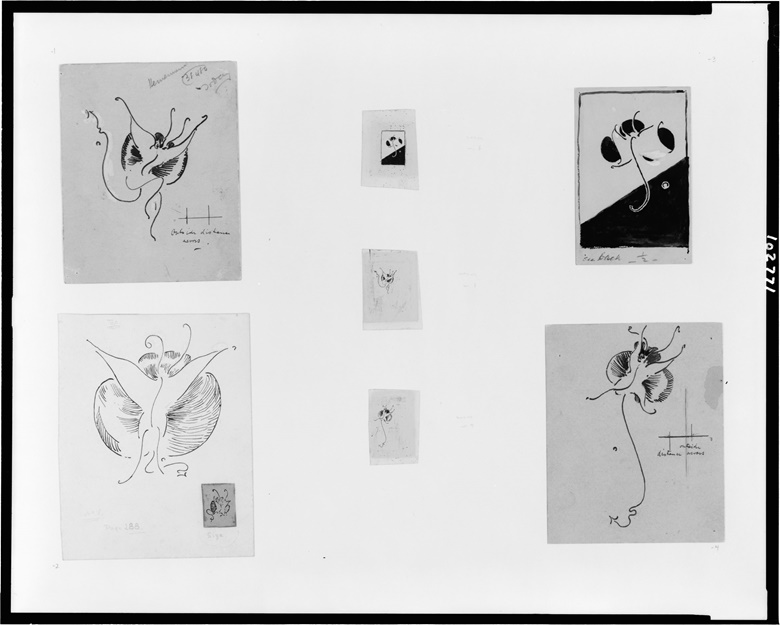
James McNeill Whistler (1834-1903), Butterfly designs, 1890-99. Seven drawings, pen and ink, white pigment, and graphite, with 4 photomechanical print reproductions
Although these variations might seem disruptive, they can actually be very useful when it comes to dating a work. 'Picasso is a great instance,' says Christie's Impressionist and Modernistic Art specialist Allegra Bettini. 'In his early on career he signed including his centre name as P R (or Ruiz) Picasso, after dropping the initial and developing a more decorative version.
'During his analytical Cubist menses he stopped signing the fronts of his canvases entirely in order not to detract from the art itself, whereas later on he adopted his famous signature, complete with an underlining dash. This was also used every bit a symbol of completion.'
- 4
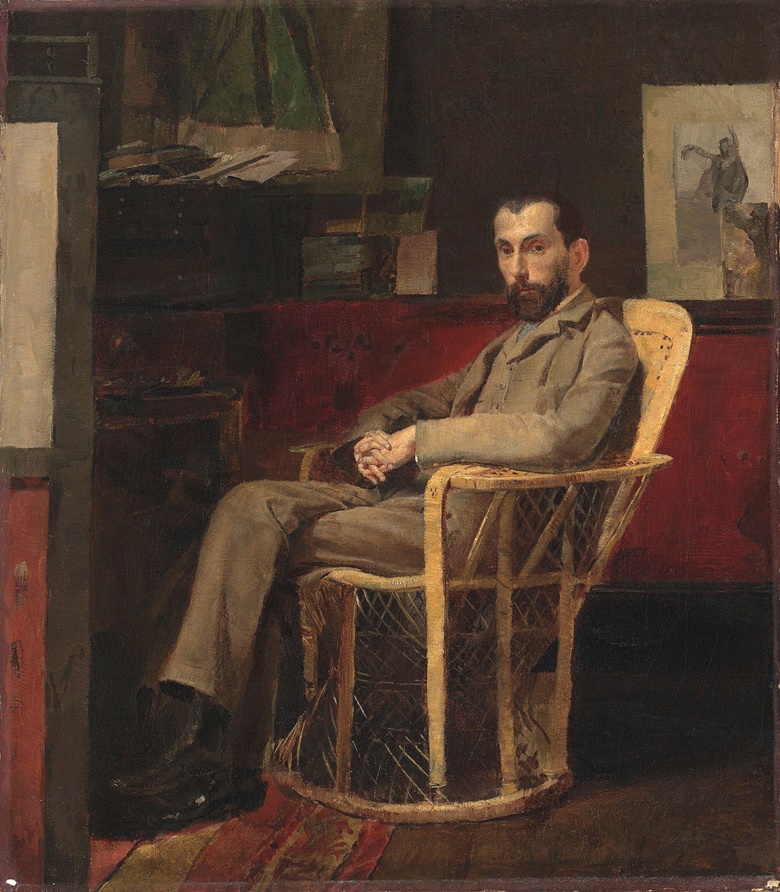
Thomas (Tom) William Roberts (1856-1931), Portrait of Louis Abrahams. Indistinctly signed, dedicated and dated 'Tom Roberts / for / friend / Don Luis / 1886' (to a higher place the sitter'south head). Oil on canvas. 16 10 14 in (40.6 ten 35.6 cm). Sold for £314,500 on 24 September 2015 at Christie's in London
Uncovering hidden signatures can reveal a wealth of information lost during the passage of time. In 2015, Christie's Australian Fine art section discovered a hidden signature and inscription by the Australian Impressionist Tom Roberts.
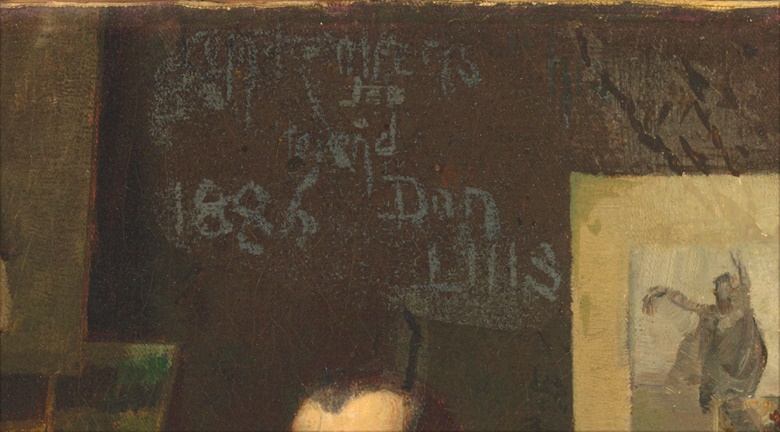
Detail showing the signature, from Thomas (Tom) William Roberts (1856-1931), Portrait of Louis Abrahams. Indistinctly signed, dedicated and dated 'Tom Roberts / for / friend / Don Luis / 1886' (above the sitter's head). Oil on canvas. 16 x 14 in (xl.6 x 35.half dozen cm). Sold for £314,500 on 24 September 2015 at Christie'southward in London
'When studying the portrait of Louis Abraham there was no visible signature,' recalls Head of Sale Amanda Fuller. 'But equally we moved the work around under the light, something caught our middle. Nosotros had the work photographed and asked our digital studio to heighten the image, and in doing and then they were able to reveal a dedication from the artist to the sitter, signed and dated, in the groundwork. It was a great moment, every bit this confirmed our suspicion that the piece of work was indeed painted past Tom Roberts.'
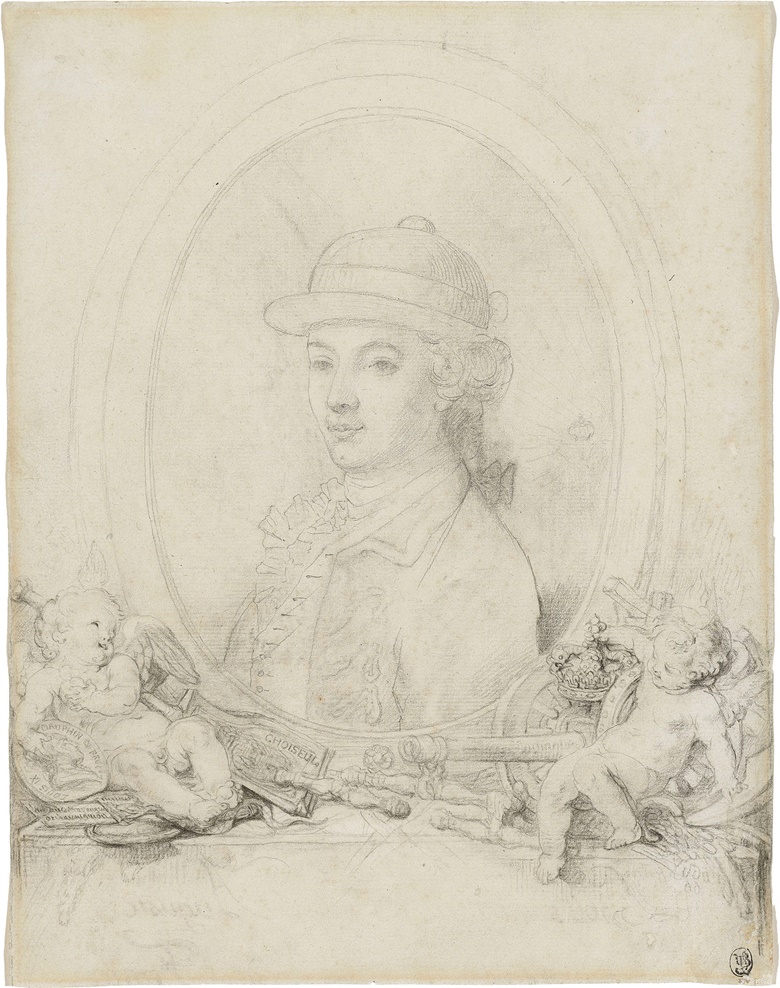
Gabriel-Jacques de Saint-Aubin, Portrait of Male monarch Louis 16 every bit Dauphin. Inscribed 'Louis IX Dauphin de France / au duc de La Vauguyon / CHOISEUL' and indistinctly inscribed at the ledge 'Louis Auguste' (in opposite). Black chalk and pencil, watermark crowned fleur-de-lys with a countermark 1000. 10⅞ x 8½ in (27.vii 10 21.half-dozen cm). Sold for £8,225 in The Dr Anton C.R. Dreesmann Collection Old Primary Pictures in 2002 at Christie'due south in London
An even more unusual case is that of a cartoon by Gabriel-Jacques de Saint-Aubin, whose portrait of King Louis Xvi was mistakenly considered to depict a woman, until most 2002. 'Funnily enough, when I was cataloguing this work a few weeks ago I really realised that "Louis Auguste" was written in reverse at the ledge,' says Associate Specialist Jonathan den Otter. 'It looks as though no one had noticed this in the past 250 years! It'due south written in the creative person'due south typical handwriting, and so information technology proves both the attribution and the identity of the sitter.'
- five
Although signatures can ostend well-founded research, they can as well be misleading. An upcoming lot in The Old Kamerbeek Collection sale briefly featured a spurious autograph by Bernardus Johannes Blommers, hiding the true identity of its creator, the Dutch painter Jozef Israëls.
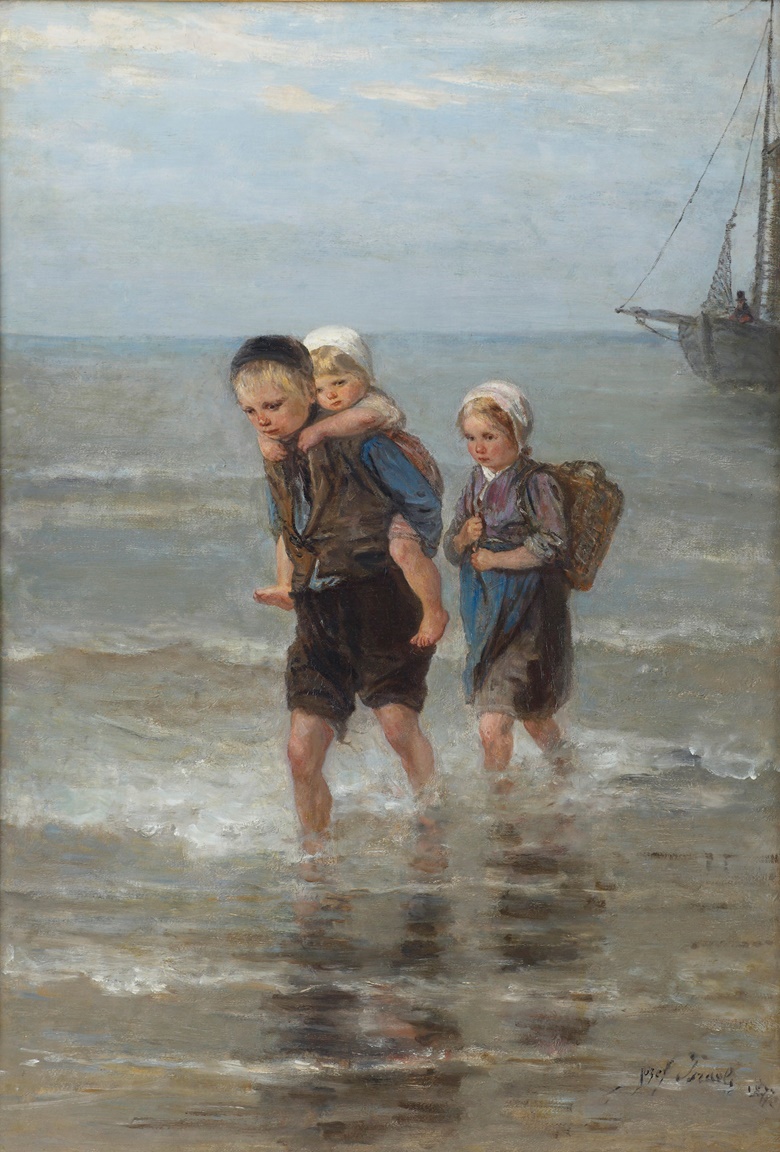
Jozef Israëls (1824-1911), Children in the Breakers, 1877. Signed and dated 'Jozef Israels 1877' (lower right). Oil on sail. 77.5 x 53.5 cm. Sold for €31,250 in The Former Kamerbeek Collection on 12 June 2017 at Christie'due south in Amsterdam
The painting was probably doctored during the Second World State of war in order to obscure the fact that the artist was Jewish, and to relieve his work from beingness confiscated or destroyed. Subsequently its provenance was questioned in 2003 the real signature was uncovered in the lesser correct-hand side of the piece, and the fake version was removed.
- 6
'Added signatures are a key consequence on the market,' says Tom Rooth, Managing director of the Victorian & British Impressionist Pictures Department at Christie's. 'They tend to autumn into one of two camps. Either a painting has been created to imitate an artist'due south work, together with a mimicked signature, or someone might add a signature to a picture at a afterward date, in order to deceive, and increase value — sometimes significantly.
'It is more often than not fairly piece of cake to detect both,' Rooth explains. 'In that location is often a concentration in execution, and a slower, more than deliberate way is apparent that yous wouldn't wait from someone signing their own name; faked signatures often lack fluidity. After seeing numerous works signed by an artist, you besides develop a familiarity with how they sign and inscribe. Of course yous can also put the painting under a UV light. If the signature has been added at a later date, the difference in pigment will show upwardly by flaring.'
Rooth also looks out for artists who might have minimal signatures. 'Myles Birket Foster was an exceptional watercolourist, but his monogram was very unproblematic. This has made him attractive to forgers who think they tin can replicate the uncomplicated 'BF' — although imitating the exceptional manus and brushstrokes of a maestro is significantly harder to get away with, to say the to the lowest degree.'
- 7
When considering whether to invest in a work of fine art it is of import to know whether an artist normally autographs their piece of work. 'If you have the selection it is always wise to favour signed over unsigned examples,' advises Rachel Hidderley. 'Notwithstanding it is crucial to remember that some artists — such every bit Stanley Spencer or Christopher Wood — never signed annihilation. And so information technology pays to remember that sometimes yous won't discover a signature at all, and nor would you lot want to.'
In research terms a signature is always ane piece in a larger puzzle. 'When we commencement encounter a work of art, of course the inscription is something we will take into consideration,' says Angelica Pediconi, a fine art conservator and art historian who has worked with international dealers, collectors and institutions including the National Gallery. 'Oft something might be obscured due to oxidation, so if we uncover annihilation we are conscientious to examine it nether a microscope.
'You have to wait at the craquelure [the network of cracks that develops as pigment layers age and shrink] to see if information technology matches the panel or canvas,' she continues, 'or work out whether it has been retouched. When we brand a discovery we are careful to transcribe our findings and consult with the owner. However, signatures are but one part of what nosotros expect for in our research. Everything you lot demand is in the painting itself — yous just need the center.'
Source: https://www.christies.com/features/7-things-to-know-about-artist-signatures-8365-1.aspx
0 Response to "Vintage Erotic Art Signatures Vintage Erotic Art Signatures Ink"
Post a Comment